
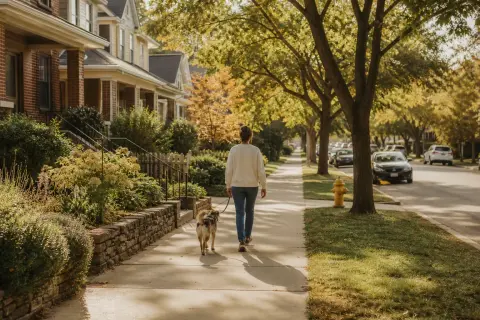
A neighborhood walk looks simple from the couch: clip the leash, step outside, come home happier. On the sidewalk, though, every block is its own little obstacle course — people who want to say hello, dogs with opinions, cars that appear out of nowhere, and the inevitable bathroom break that never happens exactly where you hoped.
Here is a practical tour of the situations that show up most often, and how to handle them without turning a pleasant stroll into a stress test.
Approaching people
Not every neighbor is a dog person, and not every dog wants a stranger’s hands in their face. Treat every human approach as an optional greeting — one your dog gets to decline.
- Ask first, then approach. A quick “Is it okay to say hi?” buys everyone a second to check body language. If your dog is pulling, barking, or freezing, the kind answer is “Not today.”
- Watch your dog’s cues. Soft eyes, a wagging body, and a loose leash usually mean curiosity. A stiff tail, whale eye, lip licking, or a sudden sit-behind-your-legs stance means give space.
- Protect kids’ enthusiasm. Children often rush in headfirst. Step between them and your dog, kneel to their level, and invite a calm hello under the chin or shoulder — never over the top of the head if your dog is unsure.
- Have a polite exit line. “We’re practicing loose-leash walking” or “He’s still learning manners” lets you keep moving without sounding rude.
If your dog is reactive to people, widen the arc early. Crossing the street or stepping into a driveway for a few treats is not avoidance — it is training in real life.
Meeting other dogs
On-leash greetings are the most misunderstood part of neighborhood walking. Two dogs who would play beautifully off-leash can look like tangled fireworks when leashes shorten their options.
- Default to a parallel pass. Walk past with a comfortable buffer, reward your dog for checking in with you, and save full greetings for dogs and handlers you already know.
- Read both ends of the leash. A friendly owner does not automatically mean a friendly dog. If either handler looks tense, keep moving.
- Skip nose-to-nose when space is tight. Sidewalks, narrow paths, and doorways leave nowhere to escape. That is when snaps and leash fights happen.
- Manage the “invisible fence” surprise. Yard dogs who rush the property line can startle even a confident walker. Create distance, keep your dog moving, and do not let them rehearse fence fighting through the barrier.
If an off-leash dog charges your leashed dog, stay calm, put your body between them if you can safely do so, and use a firm “Go home” or “Call your dog” toward the other owner. Your job is to advocate for your dog — not to force a meetup.
Automobiles and street crossings
Cars are the highest-stakes variable on any neighborhood route. Drivers may not see a low dog, a dark leash, or a sudden dart toward a squirrel.
- Assume you are invisible. Make eye contact with drivers before stepping off the curb. A raised hand helps, but waiting for the car to fully stop is better.
- Shorten the leash at corners and driveways. Blind exits are where dogs get clipped. Keep your dog on the side away from traffic whenever the sidewalk allows.
- Pause for backing cars. Beeping is helpful; quiet reverse lights are not. Give driveways a wide berth and teach a solid “wait” at the edge of the sidewalk.
- Night walks need visibility. Reflective gear on both of you, a light-colored leash, and a small clip-on light on the collar make a real difference.
- Never trust the “friendly street.” Residential roads feel slow until someone is late for school drop-off. Treat every crossing like a city intersection.
If your dog lunges toward traffic or parked cars, practice the same skills you use for squirrels: early notice, a turn in the opposite direction, and rewards for choosing you over the distraction.
Pooping and peeing on the walk
Elimination is half the reason you left the house — and it is also where neighborhood goodwill is won or lost.
Peeing
- Expect the fire-hydrant tour. Many dogs (especially males) mark as they go. That is normal scent communication, not defiance.
- Steer clear of landscaping people care about. Guide your dog past freshly planted beds, holiday decorations, and anything that looks lovingly tended. A patch of grass near a utility pole is a better target than a neighbor’s prize tulips.
- Keep moving if marking turns into a stall. Endless circling on one lawn can annoy neighbors and rehearse obsessive sniffing. A cheerful “Let’s go” keeps the walk productive.
Pooping
- Carry more bags than you think you need. One bag fails. Two is the minimum. Keep a stash by the door so you never leave empty-handed.
- Pick it up every time — yes, even in the rain, even if no one is watching. Bag it, tie it, and either carry it home or use a public trash can. Leaving a filled bag on someone else’s lawn for “later” is not a loophole.
- Choose a discreet spot when you can. Near a curb strip or quiet grassy edge is kinder than the middle of a busy sidewalk or a playground edge.
- Know your dog’s tells. Sniffing in tight circles, sudden stopping, or a particular stretch of the route often means business is coming. Shorten the leash and get the bag ready before you are mid-conversation with a neighbor.
If your dog will not go outside because the weather, noise, or other dogs feel overwhelming, shorten the outing, go somewhere quieter, or walk a familiar “potty loop” before the longer adventure. Consistency beats distance on bathroom success.
A simple neighborhood walk checklist
- Leash, ID tags, and enough waste bags
- Treats for check-ins around people, dogs, and cars
- A plan for space: crossing the street is always allowed
- Visibility gear after dusk
- Patience for potty stops that refuse to be scheduled
The best neighborhood walkers are not the ones with perfect dogs. They are the ones who notice what is coming, advocate early, clean up without drama, and leave the block a little friendlier than they found it.
Clip the leash. Take the long way home. And when the next surprise appears — a jogging stroller, a delivery van, a Labrador with big feelings — you will already know what to do.