A dog bed is not décor that happens to hold a dog. It is where your dog recovers from walks, grows through puppyhood, manages aging joints, and decides whether your couch stays hair-free. The right bed matches how your dog sleeps, how much support their body needs, and how you live — laundry, floors, climate, and chewing habits included.
This guide is the Dog Beds hub for Poochopolis. Use it to understand bed types, firmness, sizing, and breed tendencies, then branch into our supporting guides or the shop dog-bed picks when you are ready to buy. Prefer a shorter checklist? Start with How to Choose a Dog Bed.
What a dog bed actually does
Sleep is when dogs consolidate learning, repair soft tissue, and regulate temperature. A bed that is too thin lets elbows and hips grind into hard floors. A bed that is too soft can leave larger dogs “hammocked,” with joints hanging in a valley. A bed that traps heat can keep double-coated breeds restless in summer; one that offers no nest can leave curl-sleepers pacing.
Good beds do four jobs at once:
- Cushion pressure points — elbows, hips, and shoulders especially
- Support the spine and joints — more important as dogs age or carry more weight
- Invite the sleep posture your dog prefers — curl, sprawl, or head-on-bolster
- Survive your household — washable covers, waterproof liners, non-slip bases
Softness vs. firmness
“Orthopedic” on a label does not guarantee the right firmness. Think in terms of support under load, not marketing adjectives.
When softer is better
- Small and toy dogs that burrow or nest
- Curl-sleepers that like to settle into fill
- Dogs recovering from surgery who need gentle contouring (ask your vet for post-op guidance)
- Puppies that still dig and knead before lying down
When firmer is better
- Large and giant breeds whose weight collapses cheap foam
- Senior dogs with arthritis that sink until hips and elbows bottom out
- Dogs that sleep fully stretched (“starfish” sprawlers)
- Any dog that wakes stiff after sleeping on a squishy bed
Practical test: press into the sleeping surface with your palm where your dog’s hip would land. You want give without feeling the floor. For dogs over about 50–60 pounds, thin egg-crate pads often feel fine for a week and then pancake. Dense multi-layer foam or a true orthopedic mattress holds shape longer.
Memory foam contours more than egg-crate polyurethane. Egg-crate is cooler and cheaper; solid denser foam (or stacked orthopedic layers) usually lasts longer under heavy dogs. Many bestselling “orthopedic” couches use egg-crate foam — fine for value and washability, weaker as a multi-year mattress for a 90-pound Lab.
Bed types, explained
Orthopedic couch / bolster beds
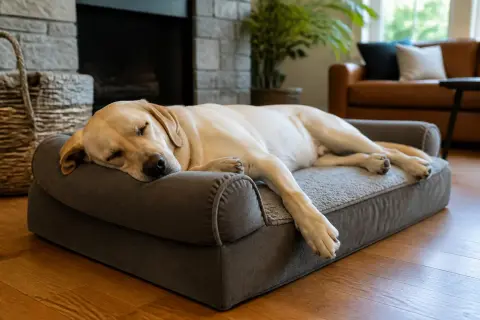
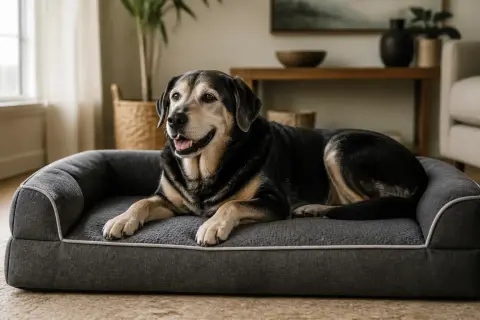
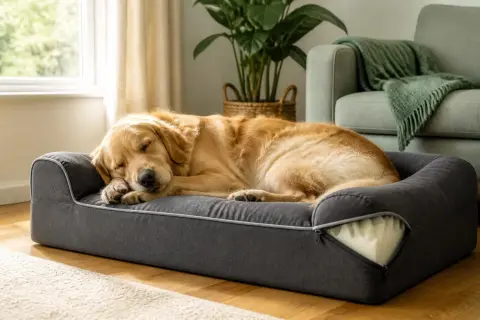
Rectangular mattress with raised sides. Dogs rest their heads on the rim, feel enclosed on three sides, and still have room to stretch. Best everyday choice for most adult dogs that sprawl or semi-curl. Look for a removable washable cover and, ideally, a waterproof liner.
Top pick: EHEYCIGA Orthopedic XL (44") — washable bolstered couch with egg-crate foam and a waterproof liner; a strong Amazon bestseller for large dogs on a budget.
Memory foam mattress beds
Thicker foam cores (often 3–7 inches) with or without bolsters. Premium options hold denser foam that resists pancaking. Best for seniors, recovering dogs, and large breeds.
Top pick: PetFusion BetterLounge Orthopedic (XL) — solid CertiPUR-US memory foam with a waterproof liner and lounge bolsters when you want denser support than egg-crate couches.
Calming donut / cuddler beds
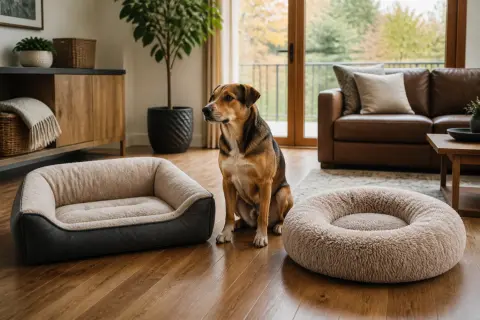
Round nest with a high rim. Ideal for dogs that sleep in a tight circle and burrow into faux fur. Poor fit for full-length sprawlers and many giant breeds. Warm — great in winter, often too hot in humid summers.
Top pick: Bedsure Calming Donut (30") — faux-fur nest with an anti-slip base for curl-and-burrow sleepers up to about 45 pounds.
Crate and kennel mats
Flat, low-profile pads sized to crate interiors. Prioritize washability and exact dimensions. Orthopedic crate mats add foam without the sofa footprint.
Top pick: KSIIA Washable Medium Crate Bed — flat, machine-washable kennel pad with an anti-slip bottom; measure your crate floor before ordering.
Elevated / cot beds
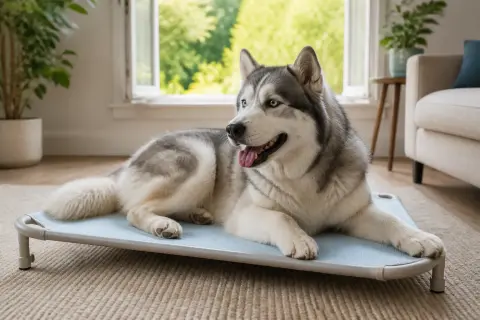
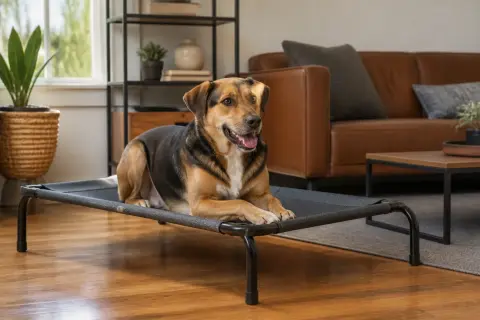
Raised mesh frames keep dogs off cold or hot ground, dry faster after swims, and resist chewing better than foam. Less pressure relief than thick foam — better as outdoor or secondary beds unless your dog clearly prefers them.
Top pick: Coolaroo Original Elevated Dog Bed (Large) — breathable HDPE cot with airflow underneath for decks, patios, and warm floors.
Cooling beds
Gel tops, breathable covers, or elevated mesh. Useful for brachycephalic breeds, thick double coats, and warm climates. Cooling tops are not a substitute for shade, water, and never leaving a dog in a hot car.
Top pick: The Green Pet Shop Cool Pet Pad (Large) — see also our Best Cooling Dog Beds guide for elevated cots and pairing tips.
How to size a dog bed (do this before you shop)
- Measure your dog from the tip of the nose to the base of the tail while they are standing.
- For sprawlers, also measure shoulder height (paw pad to top of withers) — that is roughly the width they need to stretch side-to-side.
- Add 4–12 inches beyond nose-to-tail for sprawlers; curl-sleepers can often size closer to their curled diameter.
- Compare against the sleeping surface, not the outer bumper dimensions. Bolsters eat usable space.
- For crates, measure the interior floor and leave a little clearance so the pad does not bunch at the door.
If you are between sizes, size up — especially for growing puppies and large-breed adolescents.
Breed and body-type preferences
Breed is a hint, not a rule. Watch how your dog sleeps for a week, then buy for that posture. These patterns show up often:
- Curl-and-burrow types (many terriers, shepherds, Spitz-type dogs, anxious rescues): donut cuddlers or deep bolster couches with soft tops.
- Sprawling retrievers and hounds (Labs, Goldens, many sporting breeds): flat or low-bolster orthopedic rectangles; avoid tight donuts.
- Giant breeds (Great Danes, Mastiffs, Newfoundlands, Irish Wolfhounds): thick, dense foam mattresses sized XL–Giant. Budget egg-crate couches often fail within months under 100+ pounds.
- Brachycephalic breeds (Bulldogs, Pugs, French Bulldogs): cooler surfaces, side-sleep room, and beds that do not bury the nose in deep faux fur on hot days.
- Short-legged / long-backed dogs (Dachshunds, Corgis, Bassets): supportive foam that keeps the spine level; easy on/off height for backs and joints.
- Double-coated northern breeds (Huskies, Malamutes, many collies): breathable covers or elevated cots in warm months; plush nests more for winter.
- Seniors of any breed: firmer orthopedic support, waterproof liner for accidents, and a height they can step onto without jumping.
- Puppies: washable, replaceable, and not so precious you panic at chewing. Expect to size up; many households keep a crate mat plus a “nice” living-room bed.
Materials that matter
- Foam density and thickness beat buzzwords. Ask how thick the core is and whether it is solid foam, egg-crate, or polyfill only.
- Waterproof liners protect foam from urine and spit-up. Covers that are only “water-resistant” still need liners underneath.
- Cover fabric — microfiber and Oxford blends shed hair more easily than deep shag; faux fur feels luxurious and mats faster.
- Non-slip bottoms matter on hardwood and tile.
- Zippers and compartments — two-zipper designs (base + bolster) make reassembly less miserable after laundry.
Chewers, diggers, and diggers-who-chew
No foam bed is chew-proof. Dogs that shred beds need elevated cots with protected edges (see our Best Dog Beds for Chewers guide), ballistic-fabric designs, or supervised access only. Diggers who knead but do not destroy foam often do well with Casper-style excess cover fabric or removable bolster couches. Keep soft beds out of crates if crate time becomes destruction time — use a tough elevated cot instead.
Our recommendations
We combine Amazon bestsellers already in our dog beds shop with a few top-of-the-line picks for owners who want multi-year orthopedic support. Prices are recent Amazon snapshots and change often. Links may earn us a commission — see our advertising disclosure.
Premium picks (worth it when foam longevity matters)
- Big Barker XL Orthopedic (Headrest) — The large- and giant-breed benchmark: about 7" of therapeutic foam, USA-made, 10-year no-flatten warranty, and University of Pennsylvania study data often cited for joint comfort. Choose this when you have a heavy senior, a giant breed, or you are done replacing collapsed Amazon couches every year.
- Casper Dog Bed (Large) — Pressure-relieving dual foam with dig-friendly excess cover fabric and proportional bolsters. A strong “best everyday premium” for medium-to-large dogs in design-conscious homes (roughly up to ~90 lb on Large).
- PetFusion BetterLounge Orthopedic (XL) — Solid CertiPUR-US memory foam with a waterproof liner and bolstered lounge shape. A mid-premium step up from egg-crate bestsellers when you want real memory foam and accident protection without Big Barker pricing.
Best-value orthopedic couches (Amazon bestsellers)
- EHEYCIGA Orthopedic XL (44") — Frequent #1 bestseller energy: bolstered couch, egg-crate foam, waterproof liner, washable cover. Excellent starter XL for large dogs on a budget.
- Comfort Expression Orthopedic XL (42×30") — Removable bolster for dogs that sometimes want flat and sometimes want a rim.
- BFPETHOME Orthopedic Large (36×27") — Senior-friendly positioning in a large (not giant) footprint with washable waterproof cover.
Calming nests for curl-sleepers
- Bedsure Calming Donut (30") — Medium nest with faux-fur rim; skip if your dog starfish-sleeps.
- Hoewina 20" Donut or JOLLYVOGUE 20" Donut — Budget small-dog and puppy nests.
Crate and small-dog options
- KSIIA Washable Medium Crate Bed — Flat, machine-washable kennel pad.
- Sunheir Orthopedic Large Crate Bed — Egg-crate support sized for large crates.
- INVENHO Small Orthopedic Sofa — Compact bolstered bed for toys and small breeds.
A simple decision path
- Giant / heavy senior / collapsing beds repeatedly? → Big Barker (or similar dense multi-year foam).
- Medium–large adult, wants a nicer everyday bed? → Casper or PetFusion-class memory foam lounge.
- Need a washable XL couch under ~$50? → EHEYCIGA / Comfort Expression class bestsellers.
- Sleeps in a tight circle and burrows? → Donut cuddler sized to their curled diameter.
- Lives in a crate overnight? → Exact-fit washable crate mat (orthopedic if joints need it).
- Destroys foam? → Elevated cot or ballistic bed; do not keep buying shredded couches.
Care, washing, and longevity
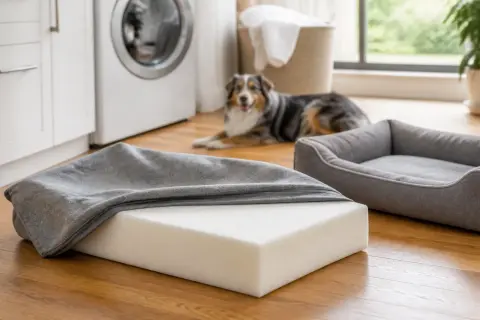
- Shake and vacuum covers weekly; wash on gentle and fully dry before reinstalling foam.
- Never machine-wash foam cores unless the maker explicitly says so.
- Rotate foam periodically so one hip zone does not compress forever.
- Keep a spare cover or a backup crate mat for laundry day.
- Replace beds that have bottomed out, smell permanently, or show chewed foam dust — degraded foam sheds particles and stops supporting joints.
For a dedicated wash walkthrough, see How to Wash a Dog Bed.