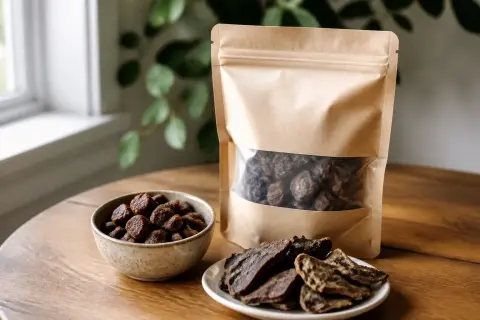

Dog food shopping at midnight is a special kind of theater: fluorescent bags whispering “ancestral,” calorie numbers hiding in the fine print, and a dog who will happily endorse anything that smells like chicken. This hub is the Food & Treats trailhead for Poochopolis — how to choose a complete diet, when wet or dry (or both) earns the bowl, how puppies and seniors need different fuel, and how treats stay useful without becoming a second dinner in costume jewelry.
Start with the dog in front of you, not the bag art. Life stage, size, activity, and any vet-guided conditions matter more than influencer mythology. Then read the AAFCO statement, plan a slow transition, and keep treats on a calorie budget. Browse curated picks in the food & treats shop, or jump into supporting guides: how to choose dog food, wet vs. dry, puppy foods, senior foods, grain-free, limited ingredient, how to transition, and training treats.
Food jobs that matter
- Complete nutrition — a formula with an AAFCO nutritional adequacy statement for the right life stage (growth, adult maintenance, or all life stages)
- Calories that match the dog — working athletes and couch critics do not need the same scoop theater
- Digestive comfort — firm stools, steady energy, coat that looks fed rather than dusty
- Life-stage honesty — puppy growth formulas when growing; senior-minded bowls when engines slow
- Treats with a job — soft bits for timing, dental chews as optional add-ons, not mystery calories
- Slow swaps — transitions that respect tummies instead of overnight bag betrayal
- Vet partnership — unexplained weight loss, chronic GI drama, itchy skin, or heart concerns belong in a clinic, not a comment section
If a product does not serve one of those jobs for this dog, it can wait on the shelf where novelty toppers go to dream.
How to choose without drowning in marketing
Ignore the wolf silhouette for a minute. Look for an AAFCO statement that matches life stage, a calorie number (kcal/cup or kcal/kg), feeding guidelines as a starting point — not destiny — and a company that publishes contact info like adults. Ingredient lists tell a story; nutrient profiles and feeding trials tell more of the truth.
Trial bag sizes save money and stomachs when you are shopping around: a Blue Buffalo Life Protection 5lb or Open Farm 4lb is a kinder experiment than a warehouse sack you will resent. Full decision framework: How to Choose Dog Food.
Wet vs. dry: moisture and crunch without a moral winner
Dry food wins on convenience, dental texture myths aside, and cost per calorie. Wet food wins on aroma for picky eaters, moisture for dogs who sip like aristocrats, and portion control in small cans. Mixed feeding is allowed — many households run dry for structure and wet for enthusiasm. Deep compare: Wet Food vs. Dry Food.
Everyday dry workhorses include Purina Pro Plan Chicken & Rice and Purina ONE Lamb & Rice. Soft loaf moments: Cesar Classic Loaf. Freeze-dried toppers like Stella & Chewy’s Mixers turn a boring bowl into a negotiation you can win.
Puppy and senior lanes
Puppies need growth-appropriate formulas — often with DHA called out for developing brains — and feeding that keeps ribs findable under a soft coat. Large-breed growth has its own pacing conversation with your vet; “more is more” is not a growth plan. Start here: Best Dog Foods for Puppies with picks like Blue Life Protection Puppy and Royal Canin Puppy Medium.
Seniors often need fewer calories for the same “I’m fine” face, plus bowls that stay appetizing when interest dips. Joint-adjacent nutrition language on bags is not a diagnosis or a treatment plan — partner with your vet for real mobility concerns. Guide: Best Dog Foods for Seniors, including Hill’s Adult 7+ and the wet 7+ Chicken Stew.
Grain-free, carefully
Grain-free is a label, not a personality. Some dogs do well on grain-inclusive diets; some households choose grain-free for preference or under veterinary guidance. The FDA has investigated a potential association between certain diets (often grain-free and/or legume-heavy formulas) and dilated cardiomyopathy (DCM) in dogs. That research is ongoing and nuanced — it is not settled science that “grain-free causes DCM,” and it is also not permission to shrug. If you are considering or feeding grain-free, talk with your veterinarian about diet history, breed risk factors, and whether any monitoring makes sense for your dog.
Picks and caveats live in Best Grain-Free Dog Foods — including Orijen Original, Open Farm Grass-Fed Beef, and Wellness CORE Ocean Whitefish.
Limited ingredient without magic words
Limited-ingredient diets (LID) simplify the label so you and your vet can do clearer detective work — often during elimination-diet protocols. LID is not automatically “hypoallergenic,” and supermarket simplicity is not a substitute for veterinary diagnosis. Guide: Best Limited-Ingredient Dog Foods with Blue Basics Turkey & Potato and Natural Balance L.I.D. Salmon & Sweet Potato. Gentler mainstream sensitive formulas like Pro Plan Sensitive Skin or Hill’s Sensitive Stomach & Skin are different tools for different jobs.
Treats vs. meals (and training paychecks)
Treats are tools. Soft training bits should be tiny, fast to swallow, and counted against the daily calorie budget — roughly a good rule of thumb is keeping extras modest so the main meal still does the nutritional heavy lifting. High-value jerky and freeze-dried liver are jackpots, not hallway wallpaper. Classic biscuits still work for low-intensity praise; dental chews are optional extras with their own supervision rules.
Deep dive: Best Dog Treats for Training. Related walking-category guide for session pacing: Best Treats for Training Sessions. Soft everyday bits: Blue Buffalo Bits. Jackpots: Vital Essentials Beef Liver.
Transition overview (do not ghost the old bag)
Most dogs tolerate a 7–10 day gradual mix from old food to new. Sensitive tummies may need longer. Pause and call your vet for vomiting, bloody stool, lethargy, or a dog who suddenly refuses everything. Toppers like Stella Mixers can help enthusiasm during a swap without turning the bowl into a buffet identity crisis. Full schedule: How to Transition Dog Food.
Toppers, mix-ins, and honest portions
A sprinkle of Stella Mixers or a crumbled Stella Beef Dinner Patty can revive interest. Subtract those calories from the daily total — toppers are not free money. Puzzle slow-downs like an Outward Hound Fun Feeder help vacuum-eaters chew instead of inhale.
A sample week that wires the hub together
- Mon: audit the current bag’s AAFCO statement and kcal/cup — how to choose
- Tue: decide wet, dry, or mixed for this household — wet vs. dry
- Wed: if puppy or senior, open the matching lane — puppies or seniors
- Thu: treat inventory — soft bits for training, count calories — training treats
- Fri: if considering grain-free or LID, read caveats and book a vet chat — grain-free / LID
- Weekend: start a measured transition if changing formulas — transition guide
Our recommendations
Picks live in the food & treats shop. Prices are retailer snapshots and change. Links may earn a commission — see our advertising disclosure.
Everyday dry stack
- Purina Pro Plan Chicken & Rice — Popular complete adult formula with strong research pedigree.
- Purina ONE Lamb & Rice — Approachable supermarket complete diet.
- Blue Buffalo Life Protection Chicken — Handy trial size for swaps.
- Hill’s Science Diet Small & Mini — Sized for little mouths and little calorie budgets.
Sensitive / LID-adjacent stack
- Pro Plan Sensitive Skin & Stomach Salmon — Mainstream sensitive option.
- Hill’s Sensitive Stomach & Skin — Vet-familiar sensitive formula.
- Diamond Naturals Skin & Coat Salmon — Salmon-forward everyday bowl.
- Blue Basics Turkey & Potato — Limited-ingredient style simplicity.
- Natural Balance L.I.D. Salmon — Smaller bag for careful trials.
Wet, topper, and treat stack
- Cesar Classic Loaf — Convenient wet portions.
- Stella & Chewy’s Mixers — Freeze-dried bowl upgrade.
- Blue Buffalo Bits — Soft training reinforcers.
- Vital Essentials Beef Liver — High-value jackpots.
- Greenies Dental Chews — Optional dental add-on with size matching.
How to use this hub
- Name the job: choose a complete food, pick a life-stage lane, compare wet vs. dry, or fix treat chaos.
- Open the supporting guide that matches this week’s stuck point.
- Buy a trial size when possible; transition slowly.
- Count treat calories; keep the main meal doing the nutrition work.
- Loop in your veterinarian for allergies, heart concerns, chronic GI issues, or dramatic appetite changes.
Read the statement on the bag. Feed the dog in front of you. Pay training with tiny soft bits. That is how Food & Treats stays a partnership — not a midnight aisle spiral with feelings.