
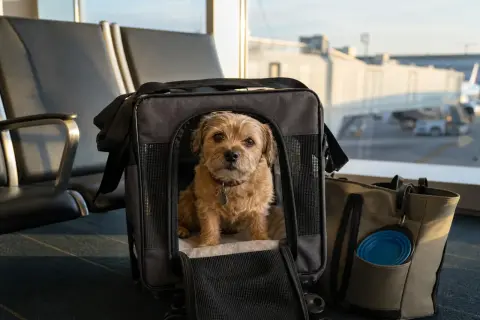
Flying with a dog is not “add pet at checkout.” It is a limited-inventory product with a zipper, a fee, and a gate agent who has seen every version of “but they always fit.” The brochure is a sleepy spaniel under 12C. The afternoon is you holding a leash in TSA while the empty carrier goes through the X-ray like a tiny haunted house.
The packing-and-practice version of this story already lives in Best Airline-Friendly Pet Travel Tips. This post is the airline map: how major U.S. carriers actually treat cabin dogs, with links to their policy pages — because a blog is not a contract, and last month’s screenshot is not either. Compare flying vs. driving in Flying vs. Driving with Dogs before you emotionally marry a nonrefundable itinerary.
Fees, dimensions, Hawaii rules, and cargo embargoes move. Screenshot the policy page with a date. Then read it again the week you fly.
Links to gear may earn a commission. We still pack the carrier we would take through a real checkpoint. Full notes: advertising disclosure.
The short version (for humans who booked the human first)
- Cabin is the product. Most large U.S. airlines no longer fly civilian pets as checked baggage. If the dog does not fit under the seat in an approved carrier, that airline is usually not a pet airline for you.
- Reserve the animal, not just the seat. Cabin pet slots are capped per flight. A confirmed human ticket is not a confirmed dog.
- Measure twice, argue never. The carrier must fit under your seat on that aircraft, with the dog able to stand and turn. “Medium” is a clothing size, not a dimension.
- The airline page is the law of the trip. Everything below is orientation. Click through. Policies change faster than your dog’s opinion of the vacuum.
Cabin vs. the hold, in 2026 English
In cabin means a small dog in a leak-proof, ventilated carrier that stows under the seat for taxi, takeoff, and landing. They stay zipped. You stay present. It is still noisy, weird, and constrained — just not out of your hands.
Checked / cargo / baggage compartment is a different product: temperature, handling, breed and weather embargoes, and a lot of “out of your control.” Several majors now limit that option to active-duty U.S. military or State Department travelers on official orders. Alaska / Hawaiian still advertise a climate-controlled baggage-compartment option for qualifying pets — with breed restrictions and date embargoes. That is the exception, not the vibe.
Emotional support animals travel as pets. Trained service dogs are a different federal category — start at the U.S. DOT service animal page, then the airline’s accessibility pages. Do not mix the two at the counter. The software will not be moved by your feelings.
U.S. airlines at a glance
Cabin dogs on domestic itineraries, for the carriers most people actually book. Confirm the current fee, carrier size, and route restrictions on the official page — those numbers are the ones that get you on the airplane.
| Airline | Cabin dogs | Hold for regular travelers | Official policy |
|---|---|---|---|
| American | Small dogs and cats, under-seat carrier | Ticket-counter checked pets: military / State Department on orders; others use cargo | American pet travel |
| Delta | Small dogs, cats, household birds (route limits apply) | Checked pets: military / State Department on orders | Delta pet travel |
| United | Small dogs and cats, under-seat carrier | Not a civilian PetSafe product — military / State Department exceptions | United traveling with pets |
| Southwest | Small vaccinated dogs and cats, domestic flights | No cargo pets | Southwest pet policy |
| JetBlue | Small dogs and cats only; no large dogs | No cargo pets | JetBlue pets |
| Alaska / Hawaiian | Under-seat pets; call or chat after you book the human | Yes, with restrictions, embargoes, and extra paperwork | Alaska & Hawaiian pets |
| Frontier | Dogs and cats (8+ weeks) on domestic flights; cabin only | No checked pets | Frontier family & pets |
| Spirit | Domestic dogs and cats in cabin (plus some small pets on domestic routes) | No cargo pets | Spirit contract of carriage (§6.2) |
| Allegiant | Domestic dogs and cats in cabin, contiguous 48 | No cargo pets | Allegiant traveling with pets |
Published fees we can point at without guessing: American lists $150 per kennel for carry-on pets on qualifying routes. Alaska / Hawaiian publish a range from $100 (up to $200 depending on type of travel and route). Allegiant’s contract of carriage lists a $50 one-way fee per carrier. Everyone else: the amount on their policy or extras page the day you book is the amount that matters. Count segments on connecting itineraries — a “cheap” ULCC can stack four pet fees before you have left the ground twice.
The majors, with the quirks that ruin Fridays
American Airlines
Carry-on pets are cats and dogs that meet size, age, and destination rules. American publishes carry-on acceptance for the 48 contiguous states, plus routes such as Canada, Alaska, Mexico, Puerto Rico, and the U.S. Virgin Islands — and does not accept carry-on pets to or from Hawaii. Checked pets at the ticket counter are for active-duty U.S. military and State Department Foreign Service personnel on official orders. Read it on American’s traveling with pets page.
Delta Air Lines
Small dogs, cats, and household birds can travel in cabin on many domestic trips for a one-way fee collected at check-in. Space is first-come, first-served with a cap per flight — you add the pet by calling Delta Reservations with kennel dimensions in hand, then check in at the Special Service Counter. Pets stay in the kennel in the airport and onboard (Sky Club included). Delta does not accept cabin pets on a list of international points; checked pets are a military / State Department product. Start at the Delta pet travel overview and the pet travel options page.
United Airlines
In-cabin dogs and cats on many domestic (and some international) flights, carrier under the seat, limited pets per aircraft. Add the pet on united.com when you book or via My Trips — the app is not the reliable path. International pet adds often need a phone call. Hawaii, the U.K., Ireland, Australia, and New Zealand are classic “the destination said no” walls, not a debate with the gate. United’s civilian cargo pet program is not the thing to plan a Lab around. Policy hub: United traveling with pets.
Southwest Airlines
Small, vaccinated domestic cats and dogs in an appropriate carrier on domestic flights; pets at least eight weeks old; no cargo pets. Space is limited — they want you to call and reserve. Each ticketed customer, one carrier; a carrier may hold up to two small dogs or cats of the same species if they actually fit. Pets stay inside in the gate area, during boarding, and in flight. A Pet Fare applies (see their optional charges); Southwest says that fare is refundable if you cancel. Disruptive behavior can end the trip at the gate. Official: Southwest pet policy.
JetBlue
Small dogs and cats only. The pet plus carrier counts as your personal item and must fit under the seat (JetBlue publishes a max around 17" × 12.5" × 8.5"). One pet per carrier; a second pet needs a second seat and a second pet fee. No exit rows, bulkheads, Mint, or seats without under-seat stowage. After you pay, pick up a JetPaws bag tag at the full-service counter. JetBlue accepts pets on all domestic flights; Puerto Rico and the U.S. Virgin Islands want vaccination paperwork. Official: JetBlue traveling with pets.
Alaska Airlines and Hawaiian Airlines
These two now share a pet-travel front door. Cabin pets that fit under the seat, plus a baggage-compartment option that still exists — with breed restrictions, fleet limits, and date embargoes. Fees are published as a range depending on how and where the animal travels. Book the human ticket first, then chat or call to reserve the animal. Hawaii and international trips add health certificates and destination rules; they will not transfer a hold pet to another airline for you. Hub: Alaska & Hawaiian traveling with pets.
The ultra-low-cost cabin clubs
Frontier
Cabin only — no checked pets. Domestic dogs and cats must be at least eight weeks old. Frontier also lists rabbits, guinea pigs, hamsters, and small household birds on U.S. flights (not your problem unless you packed a hamster). Soft-sided max they publish: 18" × 14" × 11"; hard-sided 18" × 14" × 8". No row one, no exit row. Pet stays in the container; they ask you not to offer food or water onboard. A one-way directional charge applies, payable at booking or check-in; the carrier replaces a second bag in the usual ULCC math. Official: Frontier family & pets. International pet acceptance is effectively shut for new pets — service animals only, with CDC paperwork.
Spirit
Cabin only, domestic (and U.S. territories with extra local rules). Dogs and cats in a carrier that must fit under the seat; Spirit’s contract sets a maximum around 18" × 14" × 9" and allows two similar small animals in one carrier if they truly fit. One carrier per guest. No unaccompanied minors with pets. No cabin pets on international flights except qualifying service animals. Official rulebook: Spirit Contract of Carriage, section 6.2. Confirm the current pet fee in booking extras — ULCC prices are a lifestyle.
Allegiant
Domestic dogs and cats in cabin in the contiguous 48. Soft- or hard-sided leak-proof carrier; they prefer soft-sided and publish closed-carrier maxes (soft around 18" × 12" × 11"). Up to two pets per carrier if both fit. No cargo. No exit row or bulkhead; aisle seats on some Boeing layouts are a no. Check in with an agent — this is not a fully app-native pet. The contract lists a non-refundable $50 one-way fee per carrier; connections multiply. Official: Allegiant traveling with pets and the live-animals section of their contract of carriage.
TSA is not the airline, and the X-ray is not a spa
The airline decides whether the dog flies. TSA decides how you get through the checkpoint. Their instructions: take the pet out of the carrier, send the empty carrier through the X-ray, carry or leash-walk the dog through the metal detector, never put the animal in the tunnel. Official: TSA small pets and checkpoint FAQ.
Practice a calm “out, hold, back in” at home. A first-ever unzip in a tiled hallway of rolling suitcases is how viral videos are born. Training lives in Best Dog Carriers and How to Prep a Dog for Travel.
Leaving the country is a plot twist. Coming home is the sequel.
Destination countries have import rules. So does the United States when you return. The CDC requires a CDC Dog Import Form receipt for dogs entering or returning to the U.S.; extra rabies paperwork applies if the dog has been in a high-risk country. Start at CDC dog importation and the USDA APHIS pet travel hub. Airlines can deny boarding if the receipt is missing. This is not the moment to discover forms exist.
Hawaii is its own universe even when you never leave the U.S. — American’s no-carry-on-pet rule is one example. Read the airline and Hawaii’s animal import pages before you buy the lei in your head.
What we actually take through security
Day-of logistics and the “don’t sedate from a forum” speech are in the airline tips guide. The kit we throw in the tote:
- Sherpa Original Deluxe — the classic under-seat silhouette when the airline’s published size agrees
- Sleepypod Air — structured upgrade if you fly often and the dog is still cabin-shaped
- XL pads — because terminals are not a backyard
- Ruffwear Quencher — water after you clear the maze, not a ceramic statement in 4B
Shop the rest in the travel catalog. The bigger frame is the Travel hub.
If you only change one thing
Add the pet to the reservation — on the phone if that is how that airline does inventory — before you fall in love with the fare. Then open the official policy link for that carrier, save it, and measure the carrier against the page, not the product photo.
The dog is not a carry-on until the airline says so. Treat them like a ticketed roommate in a mesh studio apartment. Zipper closed. Policy open. Coffee after you are through security, not before you have confirmed the slot.