
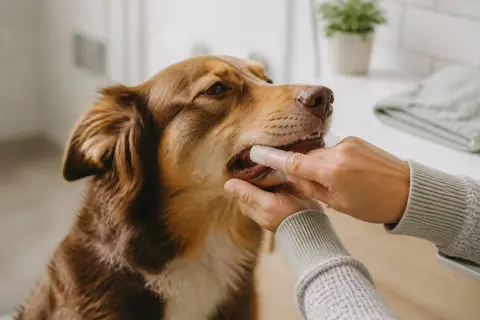
Dog dental care is the wellness habit most owners postpone until breath becomes a social problem — or until a veterinary cleaning is no longer optional. Plaque hardens into tartar, gums inflame, and pain shows up as picky chewing, face rubbing, or “suddenly hating the hard kibble.” Home care slows that arc. It does not replace professional dentistry when your veterinarian says the mouth needs work under anesthesia.
Important: Poochopolis is not a substitute for veterinary care. Dental products are not treatments for periodontal disease, tooth fractures, or oral masses. Do not use human toothpaste (xylitol and foaming agents are unsafe). If your dog’s mouth is bleeding, swollen, or too painful to touch, see a veterinarian — do not escalate brushing through pain.
This guide sits under our Complete Guide to Dog Wellness. Pair dental habits with the routines in How to Build a Wellness Routine and browse products in the wellness shop.
Who this guide is for
Owners ready to start or restart home dental care, compare brushing vs. chews vs. water additives, and understand where Veterinary Oral Health Council (VOHC) claims fit. Toy breeds, seniors, and brachycephalic dogs often need earlier professional attention — home products help, but they do not erase anatomy or age.
The hierarchy that actually works
- Daily brushing with dog-safe enzymatic paste — gold standard for plaque control at home
- Veterinary dental evaluation and cleaning when indicated — radiographs and scaling under anesthesia when disease is present
- Adjuncts — water additives, dental diets, and dental chews that earn their keep as supports
- Wishful thinking — an occasional chew while ignoring gums for years
Start as high on the list as your dog will allow. A partial brushing habit beats a perfect plan you abandon.
Brushing: the gold standard
Enzymatic dog toothpastes are flavored for acceptance and formulated without xylitol. A dual-ended brush helps you reach back teeth. Goal rhythm is daily; realistic rhythm for many households is most days with no guilt spiral when life interferes — just restart tomorrow.
Top picks: Virbac C.E.T. Enzymatic Toothpaste (Poultry) and Virbac C.E.T. Dual-Ended Toothbrush — the classic home-care pairing many clinics recommend talking through at wellness visits.
How to introduce brushing without a wrestling match
- Let the dog lick paste off your finger for a few days.
- Rub a finger or finger brush along the outer surfaces of the big canine and cheek teeth.
- Add the toothbrush with tiny circular motions — outside surfaces first (inside is harder and less critical for beginners).
- Keep sessions to 30–60 seconds early on; end before frustration.
- Never pry a painful mouth open; book a dental exam instead.
Water additives
Water additives are convenience tools. They may support fresher breath and plaque control as part of a plan, but they do not scrub the gumline the way a brush does. Use only products labeled for dogs, follow dilution instructions, and refresh water bowls so you are not serving a bacterial soup.
Top pick: TropiClean Fresh Breath Water Additive — an adjunct for households building toward brushing or maintaining between brush days. If your dog drinks less after you add anything to the water, stop and ask your vet.
Dental chews (Greenies, Dentastix, and friends)
Dental chews work through mechanical abrasion and — for some products — specific formulations studied for plaque or tartar reduction. They are treats with calories. They are choking and GI obstruction risks for aggressive gulpers. Size for your dog, supervise, and subtract the calories from the daily budget (see weight management).
Top picks: Greenies Regular Dental Treats (36-count) and Pedigree Dentastix Large Variety (51-count) — popular chew supports when your dog’s chewing style is appropriate. Skip hard nylon bones and antlers marketed as “dental” if your vet has warned about tooth fractures.
VOHC notes (how to read claims)
The Veterinary Oral Health Council awards seals to products that meet specific plaque or tartar standards in accepted trials. A VOHC seal is a useful signal — not a guarantee your individual dog will respond, and not permission to skip exams. Absence of a seal does not always mean a product is useless, but it does mean you should be more skeptical of dramatic marketing.
- Look for the specific claim (plaque vs. tartar) and the species (dog vs. cat)
- Prefer products your veterinarian recognizes
- Remember: home care + professional care beat either alone
When you need a veterinary dental cleaning
- Heavy tartar, red or bleeding gums, loose teeth
- Dropping food, chewing on one side, or refusing hard textures
- Facial swelling, nasal discharge linked to dental disease, or draining tracts
- Bad breath that persists despite honest home care
- Your annual exam flags periodontal disease
Anesthesia with monitoring and dental radiographs is the standard of care for thorough cleaning — “awake dentals” that scrape visible tartar without probing below the gumline are not equivalent. Ask your clinic what is included.
Our recommendations
Links may earn a commission — see our advertising disclosure.
- Virbac C.E.T. Enzymatic Toothpaste — Dog-safe enzymatic paste for daily brushing.
- Virbac C.E.T. Dual-Ended Toothbrush — Reach for front and back teeth with one tool.
- TropiClean Fresh Breath Water Additive — Adjunct, not a brush replacement.
- Greenies Regular Dental Treats — Supervised dental chew option.
- Pedigree Dentastix — Budget-friendly dental chew variety when sized correctly.
A simple decision path
- Mouth painful, bleeding, or swollen? → Veterinary exam before DIY brushing.
- Dog accepts handling? → Start Virbac C.E.T. paste + brush as the core habit.
- Need a bridge while training brushing? → Consider a water additive + sized dental chews.
- Heavy tartar already present? → Book a dental evaluation; keep home care as maintenance after.
- Watching weight? → Count chew calories; measure meals.
- Building the full wellness stack? → Return to The Complete Guide to Dog Wellness.