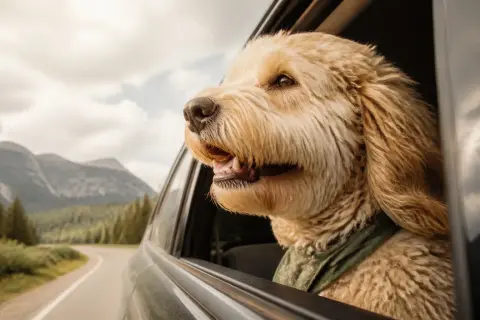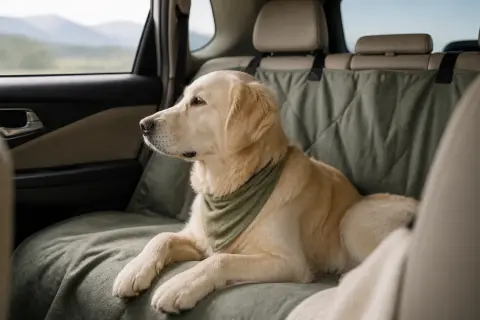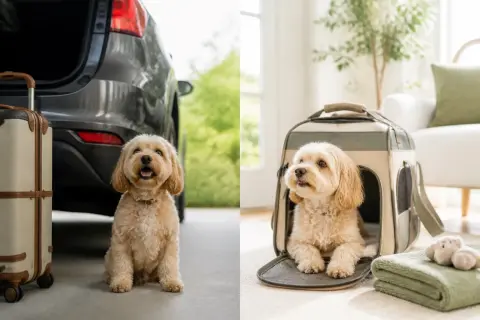
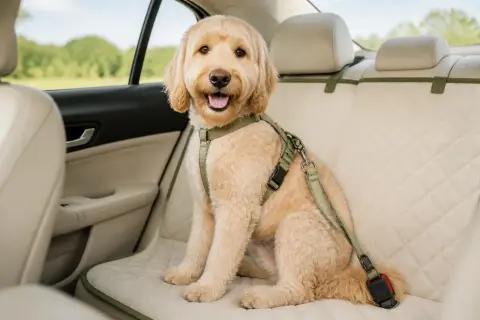
A dog car seat belt is really a vehicle harness with a job description: keep your dog in a defined zone when you brake hard, swerve for a cone, or discover that “traffic” means everyone forgot how merging works. Loose dogs distract drivers and become dangerous projectiles. Cute window selfies are not a safety plan — they are a highlight reel that physics can cancel without warning.
This guide sits under our Complete Guide to Traveling with Dogs. Pair it with How to Keep Dogs Calm in the Car so the gear and the training argue on the same side.
Who this guide is for
Anyone who drives with a dog more interesting than a statue. Errand dogs, road-trip dogs, “just to the park” dogs — sudden stops do not check your itinerary. If your dog currently free-roams the cabin like a furry GPS, this is your intervention dressed as shopping advice.
What a car restraint is (and is not)
- Is: a harness designed to connect to the vehicle’s seat-belt system or tether points
- Is: a way to limit roaming so you can drive
- Is not: clipping a flat collar to a seat belt (neck injury risk)
- Is not: a seat cover alone, a barrier alone, or “they’re good in the car”
- Is not: a guarantee in every crash scenario — but it is dramatically better than unrestrained hope
Harness restraints
The Kurgo Tru-Fit Enhanced Strength is built for vehicle connection: measure chest girth, follow the chart, and practice short drives before you invent a scenic byway marathon. A harness that fits like a shrug fails the job.
Top pick: Kurgo Tru-Fit Enhanced Strength Car Harness — everyday restraint for dogs who ride along.
Introduce it at home with treats. Let your dog wear it during boring TV. Then try the parked car. Then the driveway. Highway energy comes last, like dessert you earned.
Boosters for small dogs
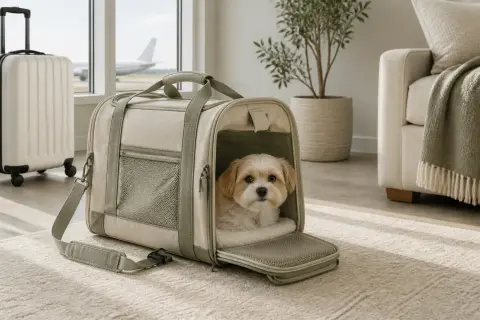
Footwells are where pedals live and where small dogs invent tragedy. A Kurgo Skybox elevates small dogs into a nest with tether points — still pair with a restraint. Boosters organize; they do not create force fields.
Top pick: Kurgo Skybox Dog Booster Seat — check weight limits and train “settle” before you celebrate the view.
Barriers and seat covers (the supporting cast)
A Kurgo backseat barrier draws a line between dog zone and driver zone — useful for dogs who believe the center console is VIP seating. It discourages; it does not replace a harness.
A Wander Bench seat cover keeps mud, sand, and shed storms on the cover instead of your upholstery. Install it tightly. A billowing cover becomes a wrestling mat mid-corner.
Top picks: Kurgo Backseat Barrier and Kurgo Wander Bench Seat Cover.
Fit checklist (do this before the cute photos)
- Measure chest girth with a soft tape — primary number.
- Compare to the brand chart; ignore “my friend’s Lab wears large.”
- Adjust so the harness cannot slip off over the legs or neck.
- Connect to the vehicle hardware the product is designed for.
- Give enough leash/tether length to lie down, not enough to visit the front seat.
- Take a five-minute neighborhood loop and re-check adjustments.
Common mistakes that make gear look “useless”
- Using a walking harness that was never meant for vehicle loads
- Leaving so much slack the dog can still climb forward
- Skipping desensitization so the dog melts down at buckle sounds
- Assuming a crate in the cargo area is secured when it can become luggage with opinions
- Cracking windows as a substitute for never leaving dogs in heat
Training the boring ride
Cars often predict parks, which predicts screaming joy. Sprinkle in trips that end at nothing exciting — around the block, home, snack, done. Teach that cars can mean “we went nowhere special and lived.” Pair with the progression in How to Keep Dogs Calm in the Car.
Our recommendations
Shop travel. Links may earn a commission — advertising disclosure.
- Kurgo Tru-Fit Harness — Primary vehicle restraint.
- Kurgo Skybox — Small-dog perch with tether points.
- Kurgo Backseat Barrier — Front-seat defense layer.
- Wander Bench Cover — Seat protection for real life.
Pack the wider kit with Best Road Trip Essentials for Dogs, then return to the Travel hub.