
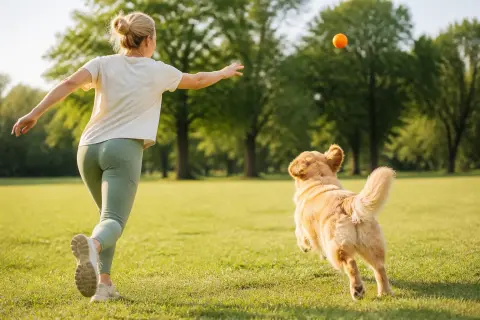
Throwing a ball from the couch is not a sport. It is a vending machine with opinions. Your dog sprints. You remain a decorative human with a throwing arm. Twenty minutes later they are still vibrating, you have not stood up, and everyone involved has technically “played.”
Play is one of the best exercise plans you already own — indoors when the weather is rude, outdoors when the park is calling — but only if two mammals clock in. This post is about getting more fitness, more brains, and fewer zoomie lawsuits out of the games you were going to play anyway.
No gym membership required. A hallway, a yard, a Chuckit ball, a KONG, and a willingness to move your own feet will do. Full notes: advertising disclosure.
The short version (for humans who have been used as a launcher)
- If only one of you is panting, it is not a workout for both of you. Change the game so you walk, pivot, hide, tug, or jog between throws.
- Indoor play is interval training in socks. Short, intense, then off-switch. Hallway fetch from the sofa is cardio for them and a shoulder shrug for you.
- Outdoor play should move the whole pair around the field — not park you at one end like a very committed statue.
- End the session on purpose. An “all done” cue plus a stuffed KONG is how you stop the dog from writing a sequel on your shins.
Why “we played” is not the same as “we exercised”
Dogs are good at looking busy. Ten minutes of chaotic fetch can spike arousal without emptying the tank — especially for brains that still have a to-do list. You can also look busy while burning approximately one calorie per throw.
What actually tires a dog (and you) is a mix:
- Heart-rate work — chasing, tugging with resistance, hills, direction changes
- Muscle work — start-stop, weaving, pulling on a tug you make them earn
- Brain work — find-it, rules, waiting, dropping the toy, finding you
- Recovery — sniffing, water, a settle, not immediately launching the next missile
Mindless repetition is how joints get grumpy and humans get bored. Variety is how both of you get fitter without turning every evening into a tennis-elbow documentary. Toy theory lives in the dog toys hub. Outdoor pacing lives in the outdoors hub.
The human half of the workout (yes, you)
You do not need a fitness tracker named after a fruit. You need a rule: your feet move whenever the dog’s feet move, except during a true settle.
- Walk the retrieve. Throw, then walk toward the landing zone while they chase. You get steps. They still get speed. Repeat in a big zigzag, not a firing squad from one spot.
- Tug is resistance training. Bend your knees. Keep the toy low. Let them pull; you provide a fair fight, not a helicopter ride that wrecks shoulders and manners. A KONG Ring is a decent indoor tug that does not shed stuffing into the HVAC.
- Hide-and-seek is sneaky cardio. You hide (or walk to another room). They search. You both moved. Apartment-legal. Neighbor-legal if you skip the opera vocals.
- Find-it on a route. Scatter a handful of kibble or training treats along a backyard loop or a hallway circuit. You walk the course laying it. They hunt it. Everyone’s heart rate participates.
- Do not outsource your entire session to a launcher. Automatic fetch machines can be useful for high-drive dogs when you cannot throw — they are not a substitute for you existing in the game. If the goal is your exercise, leave the robot in the box.
If you have knees, backs, or weather that veto running, walking the pattern still counts. Play is allowed to look like a slightly ridiculous hike with props.
Indoor play that actually works you both
Indoor play is not “lesser outdoor.” It is interval work in a smaller stadium. The trap is hallway fetch from a seated position until the dog ricochets off the coffee table and everyone learns physics.
Set a station so the rest of the house is not the arena — the longer version is in indoor play setups. Then pick games that make you stand up.
Two-room fetch (the anti-sofa version)
Soft toy only — a crinkle duck or similar, not a rubber cannonball off the baseboards. You stand in the doorway. Throw into room A. When they bring it back, you have already walked to doorway B. Next throw goes the other way. You are doing laps. They are doing retrieves. The sofa remains furniture.
Keep sessions short: five to eight throws, water, then a job that is not more sprinting. Growing puppies and long-backed dogs do not need hallway Olympics. If you hear toenails scrambling like a cartoon, shorten the runway or switch to tug.
Tug with rules (and legs)
Tug is not chaos if it has a start cue, a drop cue, and an off switch. You stand in an athletic stance — soft knees, toy at their chest height, not above their head like a piñata. Move your feet: two steps left, two right, a small retreat they have to follow. That is lateral work for you and impulse control for them.
Play “win” sometimes. Let them have the toy. Then trade or restart. A dog who never wins tug learns that the game is a scam. A dog who never drops it learns that the game is a hostage situation. Both of you should finish able to walk away.
Find-it and hide-and-seek
These are the indoor MVPs for rain, heat, and apartments. Hide behind a door. Hide the toy. Hide a stuffed KONG in another room and send them. You walked to hide it. They searched. Brains empty. Joints stay friendlier than twenty minutes of tile sprints.
Upgrade: you keep walking while they search. Lay a trail, then loop back. You got a mini-walk without putting on real shoes. They got a nose job, which is often more tiring than fetch they could do in their sleep.
The indoor closer
End with something that lowers the volume: lick mat, stuffed KONG, chew on a mat. Play without an off-switch is how you get a dog who is “tired” in the way a smoke alarm is tired. Pair the closer with the same cue every time. Then you get to sit down. You earned it. They did too.
Outdoor play that is not a throwing clinic
Outside, the temptation is to become a ball cannon and call it enrichment. Fetch is great. Stationary fetch is a missed workout for you and a repetitive-stress plan for their shoulders if you never change the picture.
Moving fetch
Throw the Ultra Ball, then walk. When they return, you are fifteen yards from where you started. Next throw goes a new direction. You just turned fetch into a walk with interval sprints — for them — and genuine steps for you.
On a long line in a safe field, you can even jog between throws. You are not racing the dog. You are refusing to be furniture. Size the ball so it cannot vanish behind molars; details live in outdoor toys and large-dog sizing.
Park circuits, not one patch of dirt
Pick three landmarks: a tree, a bench, a lamppost. Play a tiny game at each — three retrieves, a tug round, a find-it scatter — then walk to the next. You covered ground. They switched jobs. Nobody stood in one chewed-up circle until the grass filed a complaint.
Dog parks are optional, not required, and they are not automatic exercise. A reactive or overwhelmed dog at the gate is not “getting their ya-yas out.” They are collecting homework. Sniffy walks and structured play often outrun a chaotic yard. Find a park when it actually helps: near me. Outing types: trail days vs. park days.
Play on the walk
The neighborhood walk is already exercise. Sprinkle play into it instead of treating walk and play as rival religions. One tug round in a quiet driveway. One find-it in the grass strip. A ten-second hand-touch sprint (you jog backward, they catch up). Then back to loose-leash manners. The walking & training hub is the manners stack; this is the fun layer on top.
You both get variety. The walk stops being a grim commute. The play stops being a separate appointment you never book.
Hills, water, and weather
A gentle hill turns a modest fetch into real work for two sets of legs. Water play is excellent until it is too long, too cold, or unsupervised — jackets and sense: life jackets. Heat is not a personality test. If the pavement is rude or the dog is a fur factory, shorten, shade, water, or go inside. Keeping dogs cool outside is not optional reading in July.
A sample week that trains two bodies
Adjust for puppies (shorter, less jumping), seniors (more nose, less sprint), and anyone with a vet note that says “please stop being a hero on the ball.”
- Two indoor evenings: 8–12 minutes of moving fetch or tug + find-it, then a stuffed KONG closer. You should have taken a few dozen steps. They should be able to settle.
- Two outdoor sessions: 20–30 minutes of walking fetch or a park circuit. You cover a loop. They get bursts. Water in the bag.
- One combo day: neighborhood walk with two play sprinkles, then a calm chew at home.
- Rest is a training plan. Sore dogs and sore humans both cheat on Wednesday if Monday was an amateur Olympics.
If the dog is still a satellite after “a lot of fetch,” add brain, not more speed: scatter feeding, a slower puzzle, a training game from the walking hub. Arousal is not the same as emptiness.
Safety, because play is still a contact sport
- Warm up. A minute of sniffing or easy walking before the first missile.
- Cool down. Walk it off. Water. Then the off-switch toy.
- Puppies: short sessions, soft toys, no repetitive jumping off the couch into glory.
- Hard surfaces: tile sprints are how toenails and shoulders file complaints. Rugs help. Grass helps more.
- Toys: size so they cannot swallow the whole plot. Inspect. Retire the ones that become sharp or small. Nothing is indestructible, including your optimism.
- You: if tug wrecks your back, change the height or skip it. Play that injures the human is a failed sport.
If you only change one thing
Stop throwing from a chair. Walk the retrieve. Indoors, change rooms between tosses. Outdoors, move the launch point every time. That single habit turns “I played with the dog” into exercise you can both feel tomorrow — in a good way, not a “why is my shoulder a news story” way.
Shop fetch and tug gear in the toys catalog. Build the indoor station with indoor play setups. Keep outdoor days honest with the outdoors hub.
Your dog already knows how to play. The upgrade is inviting yourself into the game as a teammate, not as a very tired pitching machine.