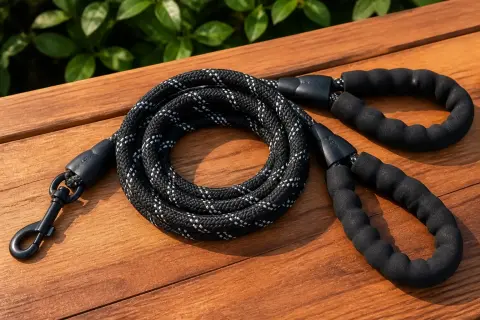
The best dog leash is less “fashion accessory” and more “length of honesty between two mammals.” Fixed length teaches consistent manners. Thin retractable cord teaches chaos with a branding slogan. Match the leash to the job — neighborhood loop, training session, or long-line recall — then stop buying novelty handles that do not change behavior.
This guide sits under our Complete Guide to Walking & Training. Pair it with Best Dog Harnesses, loose-leash tools, and the puller how-to in How to Stop Pulling on Walks.
Who this guide is for
Households whose current leash is a frayed mystery rope, owners stuck between “six feet feels short” and “retractable feels like a kite accident,” and anyone training manners who needs predictable length. You need one everyday fixed leash and, for many dogs, one long line — not a drawer of regrets.
Fixed-length everyday leashes
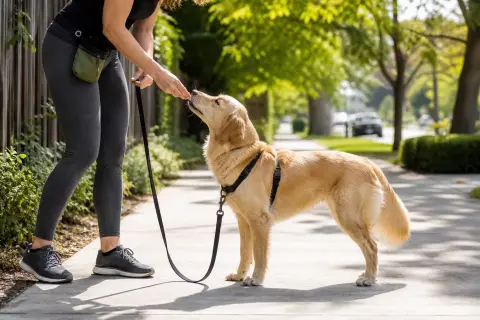
Six feet is the sidewalk classic: room to sniff, enough structure that the dog cannot invent a third lane of traffic. Look for a solid clip, a handle you can hold without inventing blisters, and webbing that does not stretch into a bungee surprise when a squirrel appears.
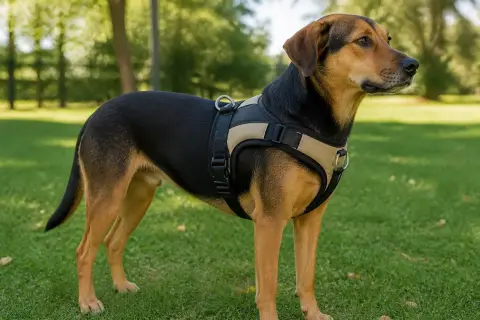
Everyday default: TwoEar Heavy-Duty 6ft — thick webbing, straightforward hardware, built for dogs who lean into life. Clip to a well-fitted harness such as the Ruffwear Front Range or Blue-9 Balance rather than yanking a collar like a steering wheel.
Four-foot leashes shine in crowded cities and training classes where six feet becomes a trip wire. Traffic leads (short) are for crossings and “stay glued” moments — not for enrichment walks that need a sniff budget.
Long lines: classrooms with a safety net
Recall practice in an open field on a six-foot leash is comedy. A long line like the Tuff Pupper 30ft lets the dog move out, make choices, and still get feedback without gambling on hope. Drag lines (dropped carefully in safe spaces) can teach “check in even when I look busy” — supervise so the line does not invent a snag injury.
- Wear gloves or use a handling technique that does not strip your palms
- Never wrap a long line around your wrist like a hostage bracelet
- Practice on soft ground first; cord burns and sudden stops are real
- Pay recall with high-value treats from a pouch — Mighty Paw or EzyDog SnakPak
Long lines are training tools, not “basically off-leash.” Local laws and wildlife still apply.
What to skip (or use sparingly)
- Retractables on busy sidewalks — inconsistent length, thin cord risk, manners confusion
- Chain leashes — heavy, noisy, rarely kinder than good webbing
- Chewed-through antiques — replace before the first near-miss into traffic
If you love a retractable for empty fields, treat it as an advanced privilege for polite dogs — not a starter leash for puppies learning the job. Puppy foundations: How to Start Puppy Training.
Clip to harness, not hope
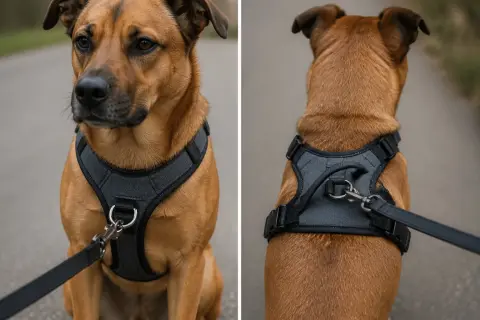
Leashes transfer force. A front-clip harness such as the PetSafe Easy Walk changes the conversation for pullers; back-clip suits hikers and polite walkers. Compare philosophy in Front-Clip vs. Back-Clip. The leash cannot fix a pay scale that rewards dragging — that lesson lives in stop pulling.
Walk kit that travels with the leash
- Bags on the leash or pouch — Earth Rated or Amazon Basics
- Soft treats for check-ins — Blue Buffalo Bits
- Optional clicker in the pouch — PetSafe Clik-R
A leash without bags is a civic plot twist waiting to happen.
Hardware and handle details that matter
Look for a locking or stout carabiner-style clip that will not invent freedom mid-squirrel. Stitching at the handle and clip should look intentional, not decorative cosplay. A traffic-handle (second grab closer to the dog) helps at curbs without shortening the whole leash permanently.
Chewers: supervise drag-lines and replace frayed webbing before it becomes a magic trick. Water lovers: rinse salt and mud so hardware does not seize into a sculpture.
Training games that use the leash you already own
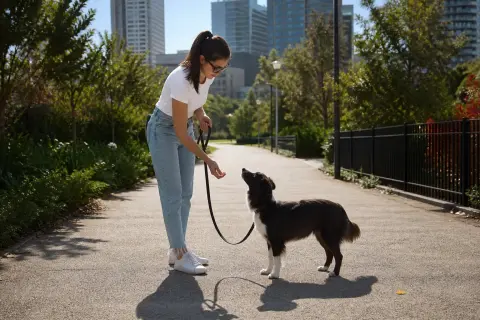
- Follow me: take two soft-leash steps, mark, treat from the pouch
- U-turn tax: every surge earns a calm about-face — forward motion becomes a privilege
- Name on the line: say the name, pay the look, then continue — builds check-ins before chaos
Keep sessions short — puppy training tips apply to adults too. Treat timing: training treats.
Quick answers owners actually ask
- Six feet or longer? Six for sidewalks; long line for training fields.
- Leather or nylon? Both fine if hardware is solid and you maintain them.
- Two dogs? Two leashes in two hands beat a coupler until manners exist.
- Hands-free waist leashes? Fine for joggers with polite dogs; skip until loose-leash basics exist.
Our recommendations
Shop walking & training. Links may earn a commission — advertising disclosure.
- TwoEar Heavy-Duty 6ft — Everyday fixed-length default.
- Tuff Pupper 30ft Long Line — Recall and distance practice.
- Ruffwear Front Range — Pair the leash with a dual-clip harness.
- PetSafe Easy Walk — Front-clip assist for pullers.
Return to the Walking & Training hub when you are ready to wire leash choice into the full manners stack.